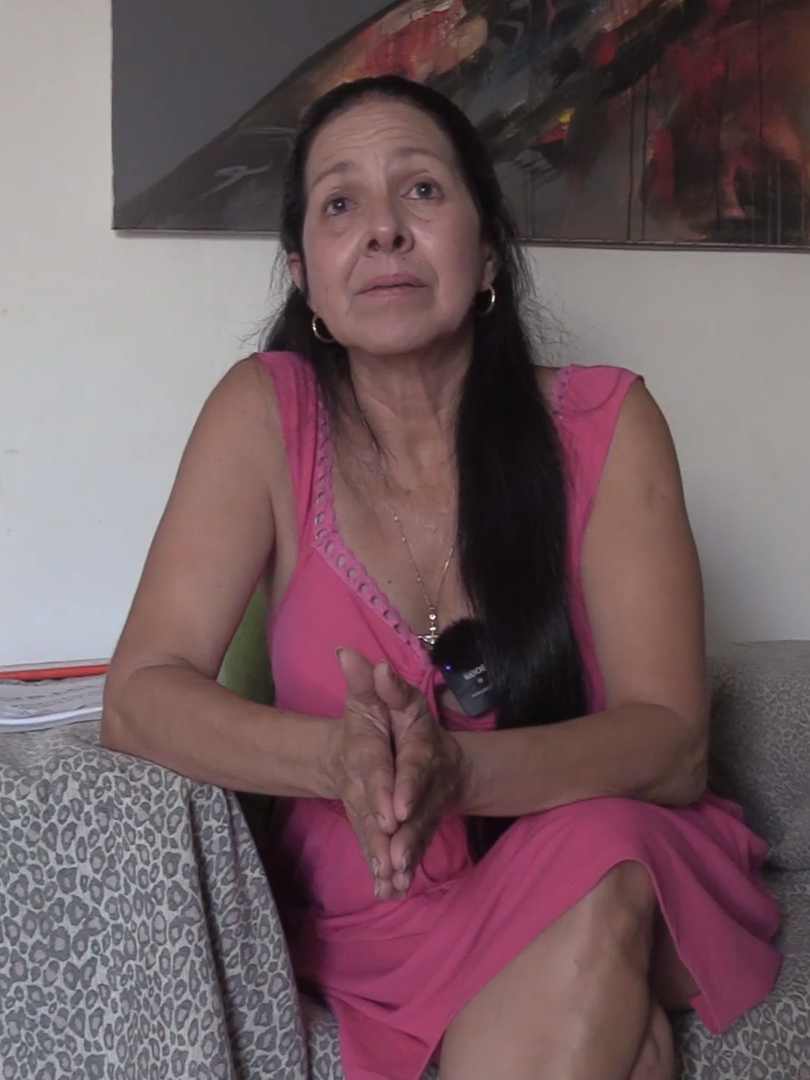
"Look... How is life in Cuba right now? It's not living, it's surviving, day by day. People look like zombies, they collapse in the streets from hypoglycemia, from lack of food. You walk past any garbage dump and you'll see one or two people, mothers with children, eating what you throw away. It's so difficult in a country where they pay you in a currency that has no value, a pittance, when there is too much demand.“ // ”There is not enough supply to meet demand, and there is no salary that can meet the needs of any household. We are all vulnerable, mothers with children, unprotected elderly people. Violence is the order of the day... 55 femicides by the end of 2024. Women and girls are totally unprotected because there is no law prohibiting minors from being with adults, and this is seen as normal in this country. These girls, who are too young to consent, are submissive, and these adults manipulate them, do whatever they want with them, and there is no solution. Drugs are in every neighborhood, there is no control. This has gotten out of hand for the government. The lack of economic and social resources. A failed state. There is not a single hospital that has the necessary resources to save lives, there is not even an oxygen tank. If you drive along the highways, you realize that this looks like a city that has been completely bombed. There is not a single street that is worth anything. The garbage dumps are growing every day and they are building $200 million hotels. With that money, they could have built a thermoelectric plant with three hospitals, ten polyclinics, and repaired many schools."
"In 2018, a patrol car stopped me near my house and took me to Criminal Investigations. My daughter wasn't so little anymore; she was in Camagüey. Melissa always knew that when my phone was off, it meant something was happening to her mom, that her mom had been arrested. She calls her brother here in Havana and tells him she can't reach her mom, that something is going on. And indeed, they detained me for eight days at Criminal Operations as if I were a criminal, looking for I don't know what, because they took everything. They locked me up for eight days in Versalles. It's like a tunnel. You don't know if it's day or night. You have to psychologically prepare yourself to endure this kind of repression. You can call yourself at two in the morning, you had no idea if it was daytime. You walk in as if it were a hotel, lots of gardens. But you walk in and it's like a tunnel down below. The lobby is wonderful, but when they lock you up, it's like a cave. One moment it was cold, the next it was hot... I was sweating, I took off my clothes. It's usually hot in Santiago de Cuba. I went eight days without eating. They told me they were going to take me to the women's prison, that if I cooperated with them, I would be released very quickly. That my daughter was desperately trying to locate me. Melissa would be about fifteen years old. That my son said that if they didn't release his mother, he was going to set fire to the University of Havana. // "They (his fellow opposition members) arrived at Criminal Operations, but I was already leaving. There are images that show this. I didn't eat. I never tasted a single bite of food. A very tall officer appeared and told me they were concerned that I was on a hunger strike. I wasn't on a hunger strike. I just wasn't eating their food. They didn't fine me, absolutely nothing. A warning letter that I didn't sign, and I went home..."
"The problem is that I was always very rebellious. I didn't understand why we had to go to political events. There were things I didn't understand, things I understand now that I'm an adult, but at that time it seemed senseless to me, like if you were passing by and they were raising the flag, you had to stop and salute the flag. To me, this was very absurd.“ // ”There was a high school teacher who taught English. I was in elementary school. The teacher got along very well with my mom, but she was leaving through Mariel. They gathered all the pioneers from elementary school to throw eggs at Isabel. She was a very polite lady who never bothered anyone. I told my mom that I wasn't going. It was the first of many acts of rebellion on my part. I didn't participate in that event even though my mom almost forced me to, because I had to comply, because of the party and I don't know what else, because look who your dad is... But I didn't go."
“I call [my family] middle class because La Playa de Siboney was considered an area for wealthy people when I was born. The only people who had access to swim there were white people.” // "My maternal grandfather was a landowner in Palma Soriano. My grandmother was a housewife, but they had employees who harvested their coffee crop. My grandfather had a heart attack when they intervened on his farm.“ // ”My father became an official of the MININT because he was one of the so-called barbudos. He went to the mountains to fight because he believed in a system, in progressive change for all citizens. After the triumph of the Cuban revolution, he was sent to La Playa de Siboney with the task of overseeing construction work and worked in the provincial Communist Party. He had his office there. I was a fairly privileged child. I don't like to talk about it much, but I had all the privileges compared to the other children who had absolutely nothing."
María Mercedes Benítez Rodríguez was born on December 29, 1969, in Puerto Siboney. Located on the coast near the city of Santiago de Cuba, this town was already a tourist hub before the Cuban Revolution. She comes from a family that had been part of the upper middle class for several generations. One of her grandfathers was a plantation owner who grew coffee. When members of the newly established regime under Fidel Castro’s command appeared on his plantation, he suffered a heart attack. Her father, on the other hand, was a member of the revolutionary forces and fought to overthrow the dictatorship of General Fulgencio Batista. After the revolution triumphed, he became an official in the Ministry of the Interior and managed many projects in the Playa de Siboney area. Thanks to this, María did not experience the deprivation that most of Cuban society had to contend with during her childhood. Their house had a swimming pool, balconies, and even several servants. Despite all this, María herself never joined any pro-regime organization. Her father did not insist on it. She studied agricultural production and, before she started working in a cooperative, she met the future father of her children and gave birth to her first child. With him in her arms, she also completed the so-called social service that Cubans must perform after graduating from college. She lived in the mountains, where she became familiar with the problems of ordinary rural people. María worked in agriculture until 2014. First as a project manager for so-called urban agriculture, then she took care of agricultural production at a sports school. In the meantime, she came into contact with the anti-regime association Damas de Blanco and subsequently became involved in the activities of many other opposition-minded organizations and worked, among other things, as the national coordinator of the organization Ciudadanos Observadores de Procesos Electorales, an initiative for the supervision of electoral processes. She also studied abroad in this field and later trained people in Cuba who wanted to run as independent candidates for local government and monitor the electoral process. She also participated in the Otro 18 project, which sought to steer Cuba toward democracy. Because of this, she became a target of the State Security agents. Even her daughter did not escape their attention. María suffered several injuries during clashes with them and was also detained for several days in a cell at the State Security headquarters in Santiago de Cuba. Despite all this, she continues to believe in the possibility of democratic change through political participation.