An elderly woman lived in this apartment. Her name was Lucyna. During the Warsaw Uprising, she was four years old, and she was evacuated. Her granddaughter told me all sorts of details about her. I never got to meet her because she didn't recognize anyone anymore, basically. I kept finding parallels between us. For example, she loved paintings very much. She had a lot of paintings at home. Me too. She loved beautiful painted dishes, me too. Through such small things, it felt like we were guests, but also like the house was welcoming us. It's hard to explain. We began gradually. And my child helped a lot too, she would say, "Oh, look, we have cups just like these. Oh, look, we love flowers and paintings too." And gradually, this apartment of a person I had never met became very dear to us. I wouldn't say it was exactly home, but it became the home of someone dear to us. That helped us too. I will always be grateful to our friends and to Lucyna, whom I never saw, for taking us in during the most difficult of times, so difficult for us. Because if all this had happened without people, I can hardly imagine it. The fact that our home is in Kyiv — that is our one home — that was somehow natural. I even had my child say, "Let's buy this for our house, for home in Kyiv." I'd say, "Wait, how are you planning to transport this later?" That is, the idea of returning was present in us, it was ever-present. When people asked me, for example, how I saw myself in a year or two, I saw myself nowhere. In Poland, I saw myself nowhere at all. I could compare it to going somewhere, and I've stepped out at a transit station to wait for another train. It's like I exist, I live, but not for any purpose, just in the moment.
We had literally ten minutes to pack. I remember what I started doing. I started wrapping paintings and an icon in blankets. We had just brought my grandmother's icon over in the fall. They had bought it at a market after the Second World War. It has no artistic value, just a thick wooden frame, but the icon itself is a 3D icon made of silvery paper with wax flowers here. That is, it has value to us because it's a family icon. It hung in my grandmother's room where we listened to all those stories, and we took. And so, before leaving Kyiv, I was wrapping paintings and icons in blankets and all sorts of throws and hiding them under the beds. I thought that if everything got blown out, they would be preserved. Then I walked through the house and photographed every room. I thought, if it's hit by a missile, I still have to have this house somewhere, to have its embodiment at least in photographs. Then I quickly packed my child's things and took absolutely nothing for myself, I don't know what I was thinking. And we left. We drove at night. We couldn't see where we were going because we had no windows. It was very cold. The GAZelle was bouncing, the dogs were whining. My child was bravely silent, just sitting there. We drove through some villages because the Zhytomyr highway was being shelled. And it all seemed very unreal, something that shouldn't have happened and shouldn't be happening, and that we weren't actually experiencing, but we were experiencing it.
Everyone who managed to get out gathered on Mykhailivska Square. And I remember — we went there too — how people hugged each other and said, "I thought you didn't make it out. I thought you didn't make it out." Because for weeks, people were still getting out. There were wounded, there were dead, and there were very many missing in action. And actually, after this, I wrote a lot about those who went MIA in Ilovaisk, because I kept imagining myself in that scenario, what if my husband hadn't made it out. He got out, but others didn't. I could have been among those whose husbands didn't get out. And I sort of, involuntarily, not on purpose, but from time to time, I put myself in that position. That topic really interested me then. I wrote a lot, traveled to the mothers and wives of those who went missing specifically in the Ilovaisk encirclement.
It was most likely not a local — at the train station in Simferopol, a huge guy in a tracksuit tore down the flag of Ukraine and was carrying it somewhere. A photographer from Poland, a cameraman, was with me, we were sort of together by then. He had also come to Crimea on his own with all of us to film something, and the fact that he was from Poland saved us in a few situations. I stopped this man and asked him, "Where are you taking that flag?" And he replied, "We're going to burn it now." I remember that it was very painful because this was literally two weeks after the shootings on the Maidan and how the dead were covered with Ukrainian flags, and here some guy in a tracksuit is cheerfully saying he's going to burn it. And he adds, "Maybe we'll burn it, or maybe we'll trample it. We haven't decided yet. This khokhol [Russian slur for Ukrainians] flag." Mateusz, the Polish cameraman, starts filming this, and the guy tells him, "Where are you from?" He says, "I'm from Poland." And then the man starts behaving differently. He starts saying, "You know, we're really waiting for Russia here. But we treat Ukrainians very well here. And we're waiting for them for the vacation season." Well, he started playing to a foreign audience, saying that we are all Russians here, that it's just a coincidence that Crimea is Ukrainian. And at that moment, when he said that we respect everyone, love everyone, I told him, "Then give me back the flag of my country." You could see he didn't want to, but at the same time, the Polish cameraman was filming. And the guy gave me the flag. He gave it to me, and I remember I rolled it up, hid it under my jacket, walked away, sat down, and started sobbing. And I sobbed, I think, even bawled. After that, this flag has been at my home, washed, ironed, waiting for its time to return to the train station in Simferopol. That is, it will return to where it came from.
It was just then that the Avtomaidan activists disappeared in Crimea, and word was that they were on the territory of a specific military base. So we all went to that base, just to be there, to stand and demand their release. I also remember that on the gates of the military base — our coat of arms was there, and it had been hastily painted over with the colors of the Russian flag. It was dripping, especially the red, and it had a kind of eerie, very unpleasant symbolism. And I remember that at some point, people, Russians, came out and started seizing equipment from journalists, taking everything they had filmed. At that moment, I was standing behind a car trying to film on my phone how they were taking the equipment from the journalists. Then a man in civilian clothes approached me. He had a weapon in his hand, I don't know, a pistol, I'm not an expert. He pointed it at me and said, "Give me the phone." I remember I hesitated, thinking, “I have so many videos on it.” And just then, my husband was filming there too, he was on assignment as a cameraman. I remember him looking at me, his face turning pale. I gave away my phone then and decided that if we were to work in any hot spots, we should never work together, because that's also about vulnerability. When you see your wife or husband is in danger, it's harder to work.
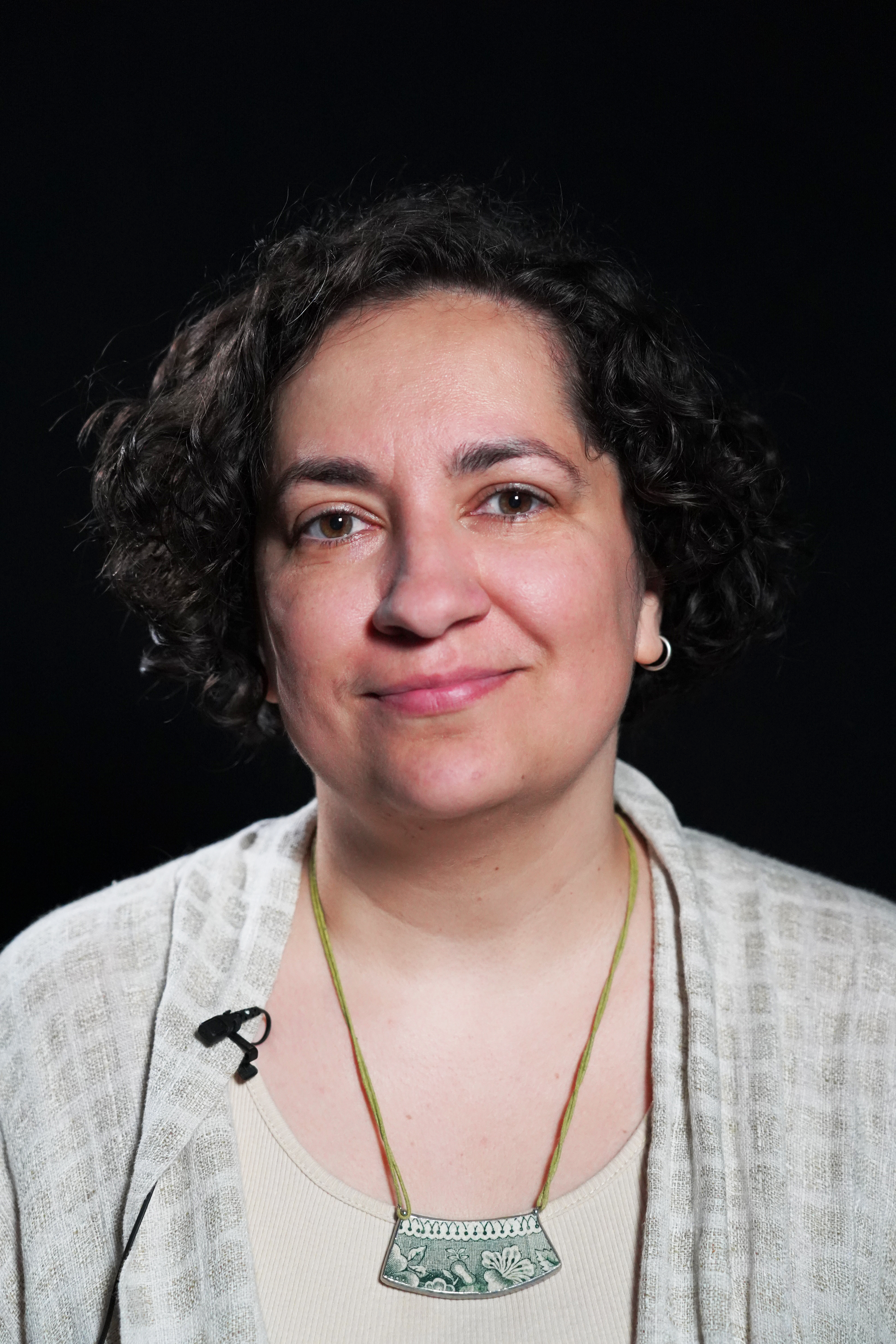
Mariia Semenchenko is a journalist, a participant in two revolutions, and was a forcibly displaced person. She was born on October 15, 1986, in Kyiv. In 2004, she entered the Department of Journalism at Kyiv International University. During the Orange Revolution, she attended protests with her classmates. She continued her studies at the School of Journalism at the National University of Kyiv-Mohyla Academy. From the mid-2000s until 2016, she worked at the daily national newspaper The Day, first as a reporter, then as the editor of the “Society” section. She participated in the protests during the Revolution of Dignity in 2013–2014. As a journalist, she visited Crimea twice at the beginning of the Russian occupation. She and her daughter left for Poland at the start of the full-scale invasion, where she spent a year and a half. While abroad, she joined the War. Stories from Ukraine volunteer project, which documented war experiences, and contributed to Polish publications. After returning to Ukraine, she collaborated with both Polish and Ukrainian media, including as a writer for the Occupation Diaries project. After her husband, cameraman Ivan Lubysh-Kirdey, was severely wounded on August 24, 2024, when a Russian missile hit a hotel with Reuters journalists in Kramatorsk, she was constantly by his side. Now, in 2025, they live together in Kyiv.