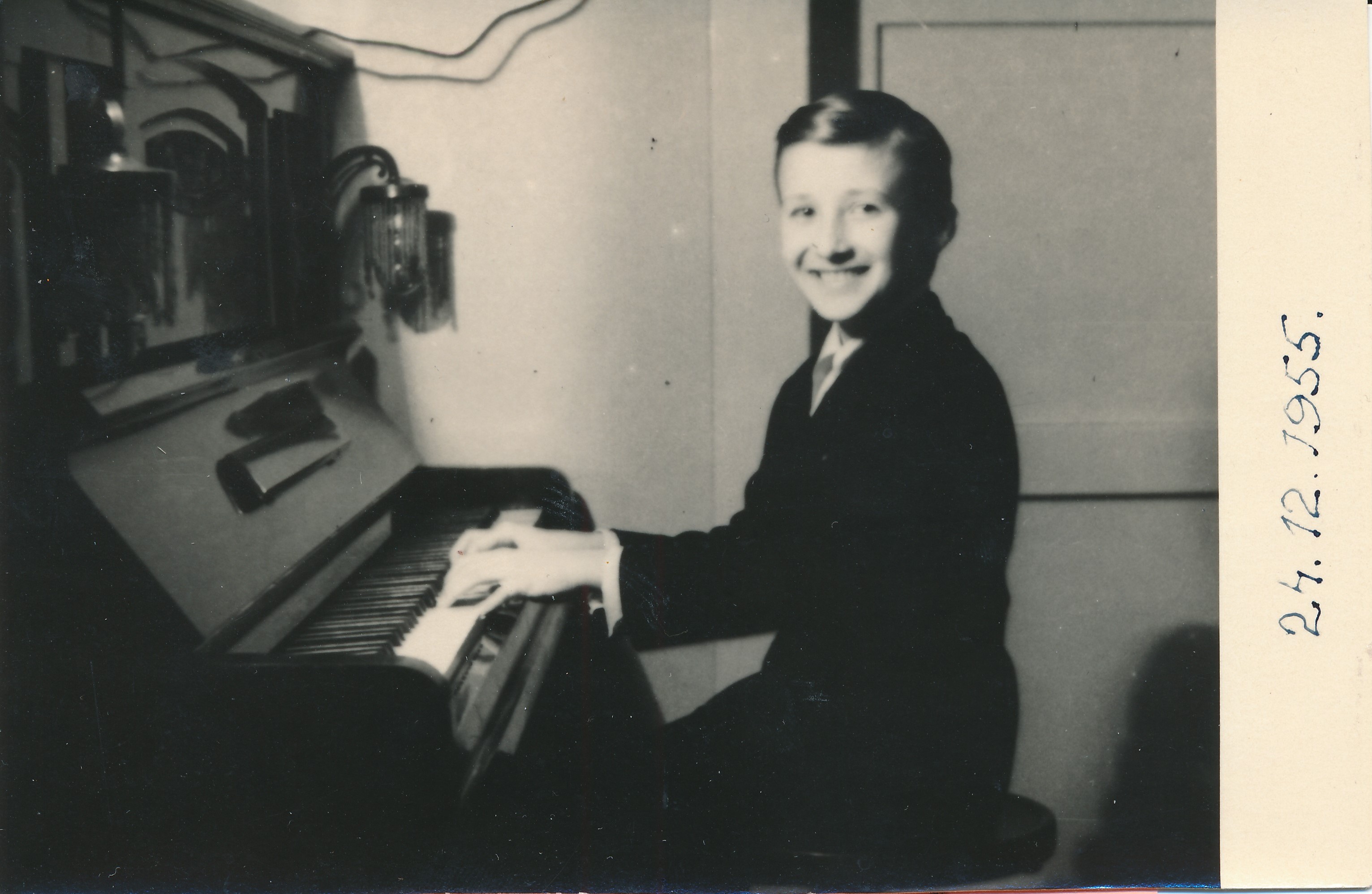
”You have to imagine: we were a bourgeois family. That meant that as a child I was a bourgeois child, and that wasn't so good. In elementary school, bourgeois children were predestined not to go to secondary school. That meant that after 15 or 16 years of elementary school, they would go into production—in the kolkhozes, the JZD, or in construction or something like that. But as is often the case, fate turns out differently than one imagines. I always played the piano as a child, from the age of five. I thought it was a beautiful instrument. But my father – you don't like to say ‘forced’ about your father, but he did urge me – to play the harmonica, the accordion. That was an instrument that was very popular in that socialist society, because with the harmonica, the garmoška, the Russians ‘liberated’ – or occupied – half of Europe, all the way to Berlin. So my father made me play the harmonica. I hated it. I didn't like the instrument. But when your father asks you to do something... And on top of that, I also had to sing Russian songs. Which I dutifully did. Imagine: there's even a nice photo of it. I played that harmonica at communist parties as a child, in choirs of screaming girls, pioneers – all in pioneer outfits: white blouses, red scarves. And I was the only boy there accompanying those girls with my harmonica. I have to tell you: I was mortified. Imagine: a prepubescent boy having to accompany screaming girls... I don't want to say that I was traumatized by it, but it did affect me quite a bit. In the end, I turned out all right. It was precisely the fact that I was such a good pioneer, that I played the harmonica and sang Soviet songs, that saved me. When I finished elementary school, as was the case in the communist era, the local party committee of the city had to decide what to do with “that child Renner.” And I was considered a kind of socialist re-educated child. The party needed such children so that they could show the parents: the parents are bad, but the socialist system works, the child is being re-educated as a socialist. As a socialist re-educated child, the party made a decision: I was given the opportunity to go to secondary school. And I seized that opportunity. That's how I ended up in secondary school, thanks to my harmonica playing. And then everything changed."
"In 1968, I was playing the piano again in that hotel in Austria. The Van der Kuilen family had long since returned to the Netherlands, to Hilversum. And then came the night of August 20-21, 1968 (the invasion of the Warsaw Pact troops). Terrible. That has been the worst moment of my life so far. Imagine: the Russians are invading. You're not in Prague at that moment, you don't know what to do, the world is collapsing. I couldn't concentrate on my piano playing anymore—unthinkable. A few days later, a card arrived from Hilversum, written by this family. There were no cell phones back then. The card said: “Hans, if you need help, let us know. We can help you. Come to the Netherlands.” A gift from heaven. Literally. After that, I packed my things. Imagine: I had Czech textbooks with me because I was preparing for exams at the faculty. I packed my books, two shirts, some underwear, and a small tent. I hitchhiked to the Netherlands. That's the striking thing about emigrating, about fleeing: you always take the wrong things with you. I never needed those Czech books again. But I ended up with that Dutch family and they took me in wonderfully. I was able to stay there. And you know, I was 21 years young at the time. You think you can stand on your own two feet, but that's not the case. You still need the smell and warmth of the nest. This family formed that nest for me. I am still very grateful to them for that.“
“I have already said that I have always done my best for the students. At the same time, like many immigrants, I have mixed feelings: gratitude for what the new society has done for you, and the feeling that you are in debt and have not yet given enough in return. It's a strange feeling, and I've always had it, no matter what I've done, right up to the present day, and I consider it one of the great achievements of my career as a professor. Let's go back to 1977. Charter 77 was founded in January 1977. On March 1, 1977, the Dutch Minister of Foreign Affairs, Max van der Stoel, paid an official visit to Prague. At the Intercontinental Hotel, he spoke with the spokesperson for Charter 77, Professor Jan Patočka. That was a heroic act at the time. Van der Stoel had the courage to meet with a dissident, someone who was hated by the communists. That made a big impression, even abroad. Since Van der Stoel visited Prague, virtually every Western politician who visited Czechoslovakia had contact with Havel, Dienstbier, or other dissidents. But anyway, Professor Patočka was then interrogated at length by the secret police. An old man, I knew him from his lectures at the philosophy faculty. A boring man, an honest man, he died of a heart attack after those interrogations. And now. History continues. The Velvet Revolution came, Havel became president, and Van der Stoel was naturally seen as a hero by Charta 77, someone who had upheld democracy in the most difficult times in formal Czechoslovakia. And then Justa (his wife) and I thought: we have to do something. There was nowhere in Prague named after him – even though in 1989 places were being renamed everywhere. But we were too late with Van der Stoel. On March 1, 2017, exactly forty years after that meeting with Jan Patočka, a park was unveiled near Prague Castle: the Max van der Stoel Park. That is our modest achievement, albeit with the help of others, such as the then Dutch ambassador to the Czech Republic, Jan Henneman. At the moment of the opening, I thought: “OK, my Dutch compatriots, now we're even.”
"Because that family actually adopted me. I had a new aunt and a new uncle. Every week, when I went to the Dutch language course – which lasted about three months and was excellent – I spent the weekends with them. Imagine being locked up in a big villa, alone with Czechs and Slovaks, all refugees. That was pretty tough. You can't imagine it. Not everyone is your friend. In a community like that, there's always tension, conflict, jealousy... It was tough. That's why I preferred to go to Hilversum at the weekend, where that family took me in very well. They were my adoptive parents. And I had another adoptive family in Belgium. Also from that same hotel in Austria—a Belgian family from the Flemish part of Belgium, from Aalst. So I had my own parents and also “parents” in Hilversum and in Belgium, in Aalst. That Belgian “adoptive father,” Herman Bostels, was a manufacturer—he had several factories for women's underwear. I visited them – especially at Christmas. It was a Catholic home and I felt very comfortable there, perhaps even more so than with the Protestant Dutch family – also because their children were younger and I learned Dutch with them: Suske and Wiske, and so on. I had a good scholarship in the Netherlands, but Mr. Herman thought it was too little. So he set up his own wonderful private scholarship for me. He said, “You know, Hansi, if you study history, you really need to travel. You have to see it all for yourself.” So he basically gave me a travel budget for the whole world. I could go wherever I wanted. Of course, he also wanted to see my grades—but that wasn't a problem. That family took very good care of me. So I had two adoptive families—that was a luxury."
"It was a course that the Dutch had set up especially for Czech emigrants after 1968. Almost all of us there were Czechs and Slovaks, about forty people, and one boy from Ceylon – poor boy, he probably had a hard time with us. It was a modern, intensive course for that time: headphones, language lab, Dutch teachers, several hours a day. Dutch was really ‘pressed’ into us. What was interesting was that they took fantastic care of us. They organized excursions so that we could get to know the country: we went to see dams, waterworks and how they function, a bull farm... You can't imagine how they took care of us back then – it was almost embarrassing how much energy they put into us. There were even psychologists available. For example, we were required to draw once a week – according to certain psychotherapeutic principles: when you draw, you let go of your worries and frustrations. So we had to draw, which we didn't really want to do – we mainly wanted to learn Dutch."
"Everyone was incredibly friendly to me. I always felt that I was being positively discriminated against in the Netherlands – everyone took care of me, students helped me, it's unbelievable. As a result, my studies went very well. All the more so because my professor was a Czechoslovakian refugee from 1948, historian Dietrich, a well-known expert in Russian and Eastern European history. He adopted me as a student, so to speak—I was often at his home, he introduced me to the academic world. I have to say that when I arrived in Utrecht, my studies in Prague were officially compared by a special committee that weighed the exams and grades from the university in Prague against what I had to achieve in the Netherlands. They recognized almost my entire bachelor's degree, with only one exception: I had to take an exam in Dutch history. And imagine – a student from Prague who, when someone gives him a book, learns it by heart. That was the ‘Prague system’ – knowing facts in detail. So I started preparing for Dutch history in the same way – I learned everything by heart. I arrived there, Professor Boogman received students at home, over coffee. He asked me questions and I rattled off all the names, dates, positions... He was surprised – and imagine that his Czech emigrant got the highest grade, a ten. That's how I happily completed my bachelor's degree."
“Do you have any brothers or sisters?” "Yes, I have a much younger sister. She was also a kind of ‘dissident’; she was even imprisoned under communism. Imagine, she was in her final year of high school. And that was partly my fault, but mainly hers. From the Netherlands, I sent various books to Prague via my students—for example, the Sixty-Eight Publishers edition of Škvorecký and other books that were not available here. I had many students, and they smuggled the books and magazines in large numbers. I sent my sister a record with protest songs by Karel Kryl. That record had already been released in the West. I solved this ingeniously by sticking a label on it saying ‘Chopin fakes’ and had it professionally sealed by a well-known record dealer in the Netherlands. So the record arrived at home as Chopin fakes. My sister lent the record out—she was seventeen, eighteen at the time... She lent it to an acquaintance, who lent it to someone else, they recorded it on a tape recorder—and imagine that they played it somewhere in Ostrava at a disco. We are talking about the mid-1970s, during the harsh normalization period. Someone played the record at the disco in Ostrava. The problem was that the secret service found out and used the recording to track down my sister. That was right during her final exams. They came to get her straight from class – the secret police picked her up and she ended up in prison in Hradec Králové. She was shaved bald – a girl with long hair, in a cell with two thieves and a prostitute, which was not the best company for a seventeen-year-old. She stayed there for about three weeks until she was released. However, she took it very well – she said herself that at least she had lost weight, so in a way she made it ‘positive’. Importantly, the principal of that high school – a communist I knew well, because I also attended that school – allowed her to complete her final exams despite everything. His pedagogical and human side was more important to him than his party membership. Thanks to him, the communist, my sister got her high school diploma. What I mean to say is that not everything is black and white. There is a large gray area. Not every communist was a villain. Many were ‘radishes’ – red on the outside, white on the inside. I always said to my students in the Netherlands: you can't condemn everyone just because they were members of the party. The reasons varied. And for many communists, humanity ultimately prevailed. Well, Gorbachev was also a communist."
"You know, I would even admit that I tried to suppress the Czech connotation at the time. Perhaps it was an instinct for self-preservation. I love music very much. Imagine arriving in that new country and not being able to return. That's important. In the Netherlands, they call it ‘heimwee’, homesickness. Listen to Dvořák's 9th symphony – there you have it. Homesickness is difficult to define. It's the smell of bread from your childhood, a babbling brook, it's the little things that remind you. And now imagine you can't go back. There are two possibilities: you succumb to homesickness, and you feel terrible, or you reach another stage. Emigrating is like a flower. When you transplant it, there are two options: either the flower blooms, or the plant dies. There is really no other possibility. I suppressed my homesickness. In the first phase, when I got to know Justa, I therefore completely stopped reading Czech books (except for Rudé právo – I read that for my thesis) and, above all, I couldn't listen to Czech music. Dvořák, Smetana – that was impossible. How do you solve that when you love music and can't listen to Dvořák? I solved it by throwing myself into studying Brahms. He was Dvořák's teacher, always taking good care of him. Dvořák has one of his important works – the Slavonic Dances – which I couldn't listen to at the time. But Brahms has Hungarian dances – and some of their orchestrations were performed by Dvořák. So I listened to Brahms, but in fact it was Dvořák's orchestration, which I didn't know at the time. These are small things, but emigration is a great disaster. If you don't have to, don't do it. And then there are the emigration dreams. Ask any emigrant, any refugee. They always return and are always the same. Do you know what it's like when you dream that you're back, say in the Czech Republic? You're in the Czech Republic and you want to go back, but you can't. Those are nightmares. Emigration dreams come a few times a year, but they are terrible. The whole day after, sometimes even two days, you are confused. And the strange thing is that they disappear as soon as you can return. That's how it was for me."
"I am afraid of the Russians. Period. I am afraid of Putin. You probably know why, given the situation we find ourselves in today. And I am not naive. I am too much of a historian for that; I know Russian and Soviet history, including the period after the fall of the Soviet Union, in considerable detail. I am not naive. And I realize, more than the average European, certainly more than the average Dutch person and perhaps even more than the average Czech, what danger threatens Europe from this quarter. Ukraine does not have to be the last to pay for it. No."
Hans (Hanuš) Renner (1946, Prague) is a Dutch historian of Czech descent and professor emeritus of Central and Eastern European history at the University of Groningen. He comes from a “middle-class” family; his father, who was the director of a large trading company before 1948, was demoted to manual laborer after the communist coup, and the family moved to Litomyšl. Thanks to music—piano and, above all, the less popular accordion—he was admitted to secondary school as a “socialistically re-educated” middle-class child. After graduating, he studied history and philosophy at the Faculty of Arts of Charles University, shaped by the Prague Spring and reading Solzhenitsyn’s One Day in the Life of Ivan Denisovich. In the summer of 1968, he played piano in a spa hotel in Austria, where he had previously met a Dutch family from Hilversum. After the invasion of Warsaw Pact troops, he accepted their invitation and emigrated to the Netherlands in September 1968. After an intensive Dutch language course, he studied history in Utrecht, where he graduated in 1973, taught at a secondary school, and from the mid-1970s worked at the University of Groningen, where he became a professor. In 1973, he married Dutch woman Justa in Naarden at the grave of Jan Amos Comenius. After 1989, he was rehabilitated and honored by President Václav Havel. He has long been involved in Czech-Dutch relations, critical reflection on communism, and education about the value of freedom and democracy.