At first, I lived with one friend, then with another. And this ritual of packing my things for a certain period of time... I can always come and take more. It's not a refugee experience. But I have this, and I have to move on with it. Through other people's apartments, through other people's neighborhoods. I have a job or somewhere to go. I build new routes almost every day because I live with this backpack and bag. Yes, a big one. At some point big, at some point smaller. Ten days in one house, ten days in another house. Sometimes without owners, sometimes with owners. Sometimes in a house where no one knows I live there. That happened too. And I started to track what home means to me in principle. And how these rituals, little things [give me a sense of home]: where do I put my headphones when I take them off; where do I feel comfortable and uncomfortable putting my charger? What things give me a sense of space? Lying on the floor and listening to voices or when I get to know the surrounding area. For me, before, because I didn't have a home-home... My first home — I was very young. My second home, on Naukova [Street] — it was my parents' and very strict. For me, my home was the neighborhood — everything I could walk around. In Hanover, it was my home, but apart from my home, there was nothing else. There was my fortress, my room, where I could host people, where I could live alone, and where I felt comfortable being alone. And I wasn't afraid. And then I lived with Vlad, and it wasn't home. It was something we tried to build for a very long time, but in reality, I was just trying to fit into his routine, and he was trying to expand it to fit me in, and we didn't both fit there. And since then, I've been looking for a place like that.
And it was a very strange experience in general, living in isolation from everyone else. This metaphor of my move as death continued, because I felt like some kind of heavenly force. Kharkiv is happening somewhere below my feet, but I am not connected to it, I cannot touch it. I can hear them, they can call me, but that's where it ends. I can't tell them anything, I can't convey anything to them. I just exist incorporeally above all this. And when I started coming here, I began to explore this city a little after giving it up in this way. And there was a moment when I realized that returning was a must. It was a slightly poetic moment. Vlad and I went out for a walk to buy something at the store. There was a store right next door, we went out onto the street and were already going in. I heard a sound. I realized it was a bird and that I hadn't heard that sound in maybe over a year. And I started crying because it was really the sound of a bird that I recognized, that I had heard since childhood, heard all my life, and here I hadn't heard it for several years while living in Germany. And for me, it was so unfair to live in a country where you can't hear this bird. It seemed absurd to me that I couldn't do that.
I got really into movies, and on the night of [February] 22, on the eve of the 22nd, I watched a movie about war with McAvoy. Before that, I wrote a poem about war in Russian because I watched a movie about... For some reason, almost all the movies I came across at that time were about war. One was about knights and their war, about their conquests, and I wrote about the work of going and dying, in Russian. And when the full-scale war began, we obviously slept through it because we were in another country. But when I woke up, I was the last one to wake up. I woke up in a house where everyone was on their gadgets, typing, calling, writing, sending something, trying to do something. I woke up, ate, and sat down too, and we started looking for information, looking for who to evacuate, spreading the word, doing something. Because we had the time and resources to do so. Because the people here, at that time, they had other things to worry about. For a while, my channel became a place where I compiled a lot of useful information for others that I would not use because it was irrelevant to me. About explosions, how to classify them, what to do in certain situations, how to get to certain cities, which evacuation trains. It was difficult for me to post anything about myself and talk to people in general because I didn't know how to support them, being so far away, in a completely different situation. And I could see how this experience was dividing us, and I didn't know how to talk about it.
[Anticafé] Tsyferblat was such a... And the whole city, as I saw it then, was so new to me. I remember it now, as I saw it then, and everyone told me that St. Petersburg would suit me very well. And I remembered it with the idea that I had to visit the Altai region, and I perceived Kharkiv as a small St. Petersburg. Even my memories of it now are how I imagined St. Petersburg back then, not how I know Kharkiv now. That is, it is different. I have never been to Russia, nor have I visited St. Petersburg or Altai, obviously. But it was all like a continuation of the city. The city seemed to extend not to the west, but to the east, to the east and upwards. As if something of mine was there, further away. This was also evident at our university, where everyone spoke Russian until a certain decree was issued in [20]19. Everyone spoke Russian, everyone staged Russian plays in Russian. We were given the task of looking at a list of plays, or rather a list of productions, and most of the performances were by Russian theaters. That is, there were fewer foreign performances than Russian ones. Yes, perhaps good performances. But it was a dominant environment, where people went to study, from which they came to us to study. That is, there was a constant flow. If you study well, you either go to Kyiv or you go straight to St. Petersburg, to Moscow. It wasn't in my imagination... I was in Kyiv and Lviv more as a tourist. But, first of all, we in Kharkiv have a certain competitiveness with other cities. All that “first capital,” this imperial narrative. But Kharkiv has always been like a city-country.
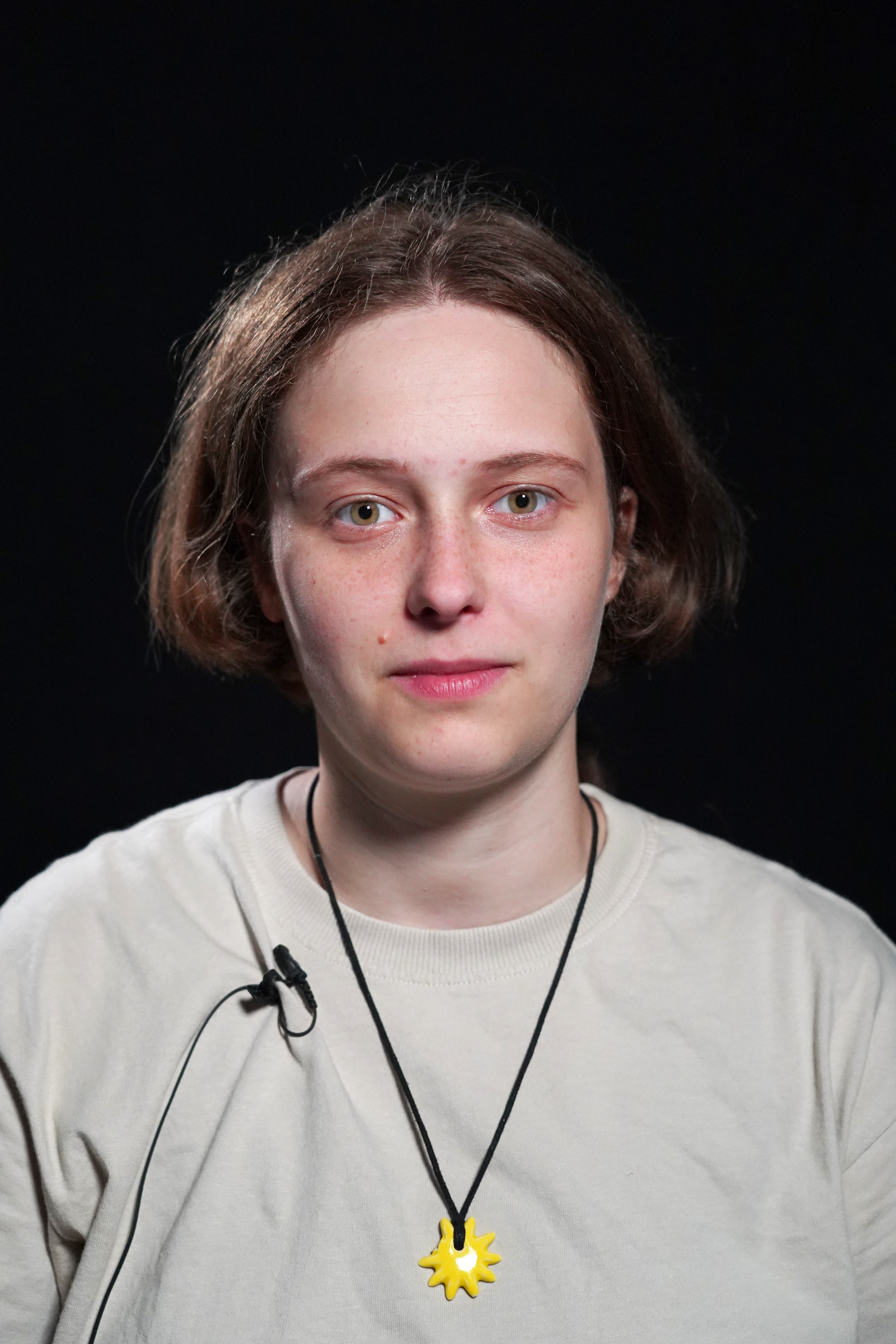
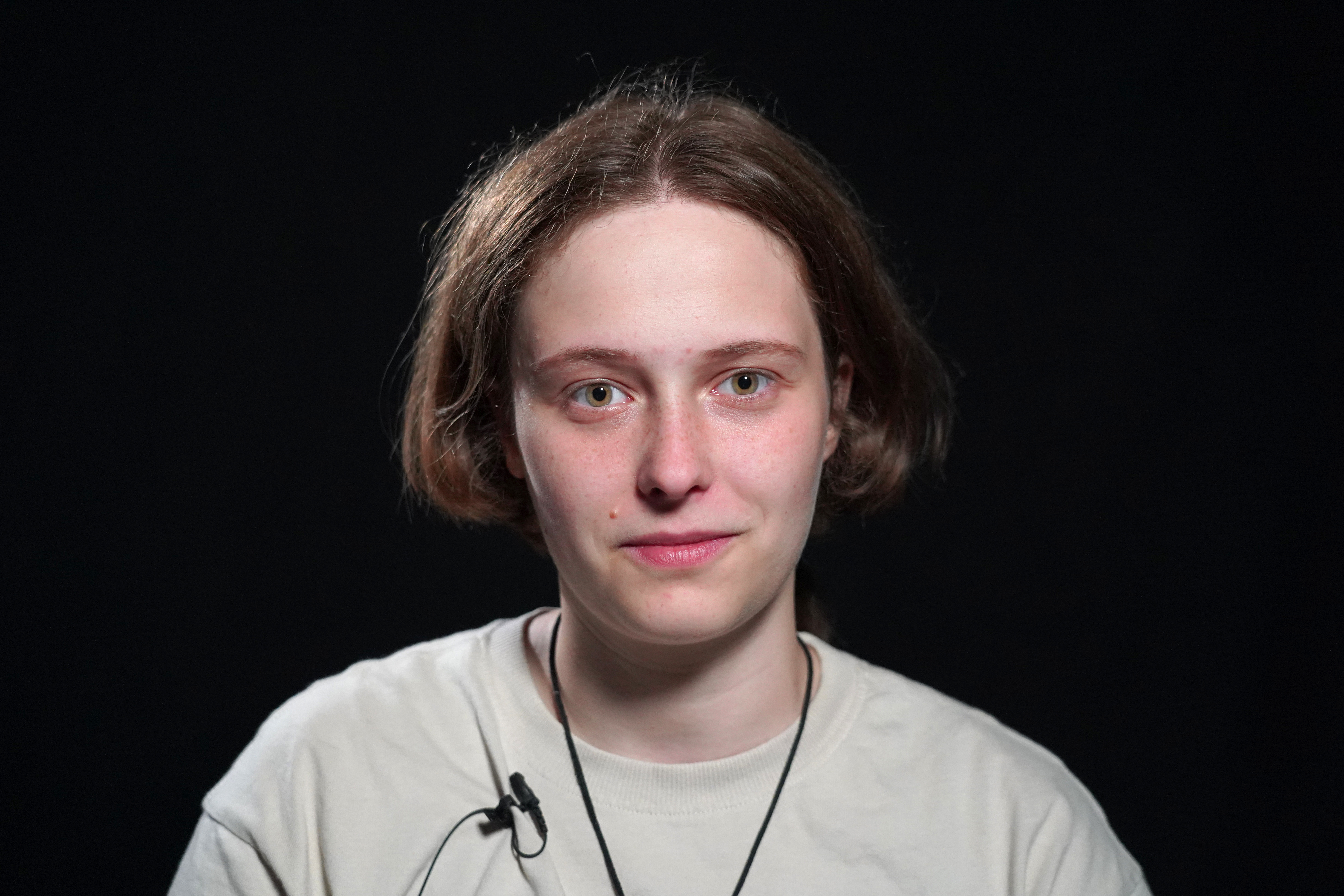
Deniza Glezina is a playback artist and cultural manager from Kharkiv. She was born on September 1, 2000, in Hanover, Germany, where her parents planned to build their lives, and grew up in Kharkiv. In 2017, she enrolled at the Kotlyarevsky Kharkiv National University of Arts, where she studied directing. During her student years, she began organizing poetry readings in apartments and discovered playback theater. She joined the More Nocturn theater. In 2021, she emigrated with her family to Germany, where she witnessed Russia’s full-scale invasion of Ukraine. She volunteered and helped build a Ukrainian playback theater center in Hanover, including the Korali Theater (later renamed Kochivnyky). She returned to Ukraine in 2023. After her return, she joined the creation of the Nema playback theater and co-founded the Kharkivske More local culture festival. In 2025, she is developing the Kharkiv Playback Theater Center to promote understanding within Ukrainian society.