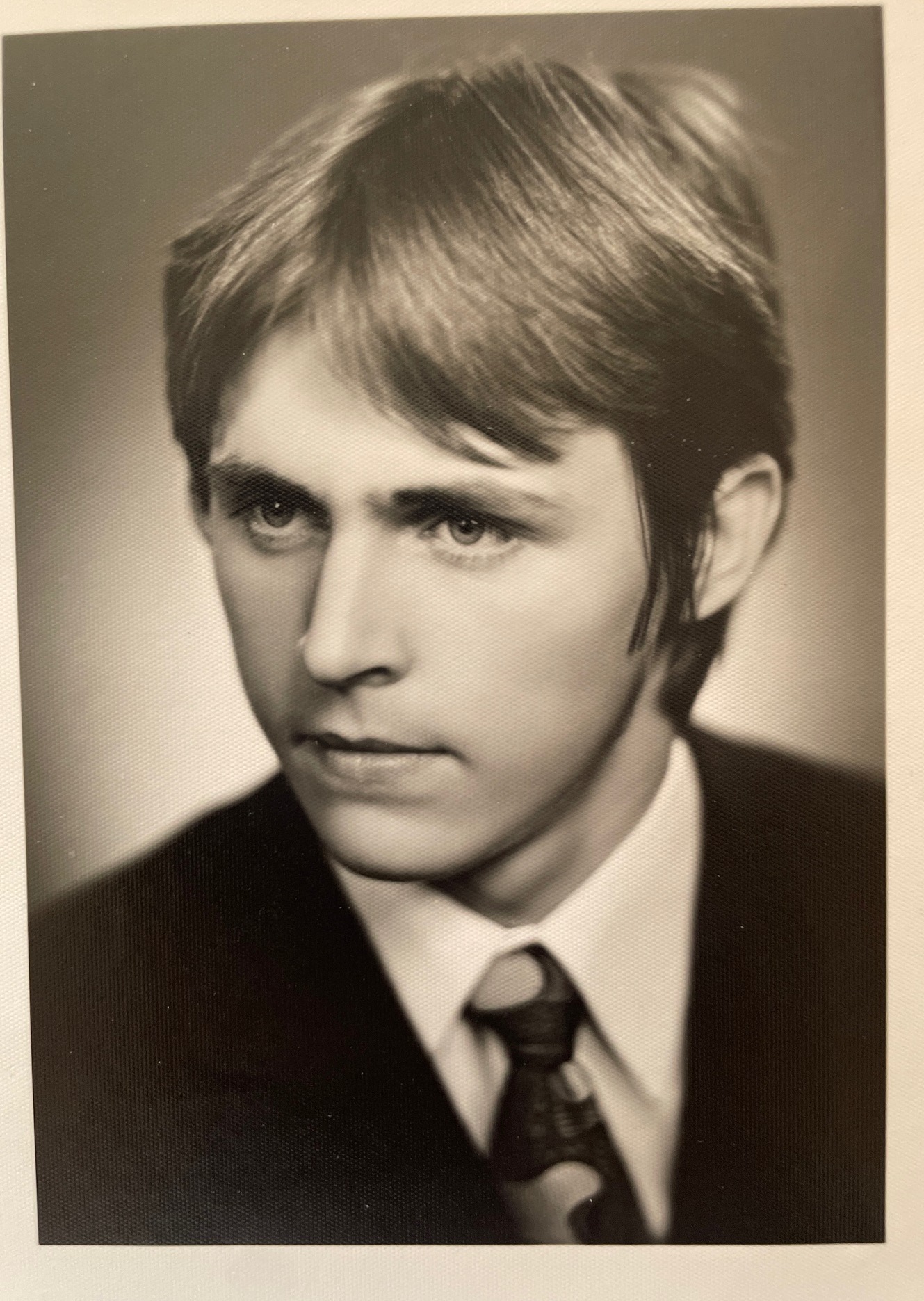
After 1968, my father had problems and was stripped of his membership in the Communist Party. He was a party member and wrote banners day and night in support of Dubček and Sloboda. Basically, the whole family was democratically inclined. His cousin told me that they had always been democrats. After the war, when bread was broken and the communists won, the whole village of Vinosady was democrats. Basically, they were right-wing. My father had a position and proclaimed - Dubček, Sloboda, the guarantee of the nation. I was 15 years old and we lived above Topoľ, in Topoľčany, where there was a main intersection from where you could go to Piešťany, Prievidza and Nitra. It was a main intersection and there were troops and columns there. Everything was going on there and we could basically watch everything. There were mostly Bulgarians and Hungarians there. I somehow didn't see any Russians there. That was probably because the Hungarians and Bulgarians were coming from below. There were only these two armies to be seen. Then normalization came, my father suffered and had two heart attacks, so it affected him quite a bit. There were four of us children, so my mother joined the party because she knew how it worked. She thought we needed the support of the party. I didn't understand that.
Then a great tragedy came and we had a serious accident. It was June 24, 1976 (June 27, 1976), the day after a plane crashed in Zlaté Piesky. We had summer training and the next day we were getting ready for a match in Turkey. It was under coach Michal Vičan. We had training in the morning and Jano Čapkovič, Ivan Pekarík, Jožo Čapkovič and I agreed that we would go to the Vajnorské Lakes during the break between two training sessions. Ivan Pekarík always had a fishing rod - a poacher, so we would go catch fish. But Tibor Matula, who was the substitute goalkeeper for Šaňa Vencel, asked Jožo Čapkovič to take him to Galanta during the break because he needed to take care of something urgently. So in the end, only the three of us went: Jano Čapkovič, Ivan Pekarík with his car and me. As we arrived at Vajnorské Lakes, a terrible storm started - hail. So we jumped in the car and drove to Zlaté piesky, hoping to wait out the storm and at least have a coffee there. There were no lights there yet. Now the intersection looks completely different. In the main stream, you could turn left, to Zlaté piesky. But from behind, there was thunder - hail was falling, so a truck loaded with gravel from behind was going full speed. We were standing in the middle of the road, which meant we had to give way to trucks from Bratislava. He was coming at us at full speed. At the last moment, he wanted to turn the steering wheel, but the road was wet, so he didn't have time and flew into us. The car was basically a piece of scrap, it was spinning us, and a 613 crashed into us from the front. I had a dislocated hip and I was crushed there. The guys, I mean Jano Čapkovič, was at his best. The cars stopped right there, they started to pull us out with some jacks. They were pulling me out because I was stuck in the back. They took us right away to Kramáre. I stayed there until the afternoon, until I got to the advice. I alternately passed out and was conscious. There were some kids who had an accident and were ahead. In the evening, when I was already in the room, a nurse told me that you will have good patients, a plane crashed in Golden Sands. And basically almost everyone died there, about three or four were saved.
They set up some kind of political party that was in charge of liquidating the facility. Eventually I learned that it was someone who handed out red diplomas and had a father-in-law who worked at the VUML (Evening University of Marxism-Leninism). Because everyone who wanted a position had to study Marxism-Leninism. In the end, the director of the company was a cadre, someone's son-in-law, and they used him to say that Matadorka had to be liquidated. So they gradually and slowly dissolved entire departments. About three thousand people lost their jobs there at that time. When I was still going out to my clients, they asked if they needed, for example, conveyor belts. I brought them information and lists of goods, what all the clients needed. They were absolutely not interested and did not even answer.
Eventually, when the rubber factory in Matadorka was liquidated, I learned that the formulas that were for rubber had ended up in China. Our people went on monthly internships there to teach the Chinese and lived directly in the company. The Chinese bought equipment in the Czech Republic and the technology that they produced there for us. They also took some rubber preparation presses from there. They took it there, disassembled it and started producing rubber themselves, with the contribution of our technicians. I also know which ones. I found out that two of them went on monthly internships there. The biggest joke was that the production that was produced here in Slovakia in Matadorka began to be missing in the Czechoslovak Republic. Highways began to be built, they needed sealing boards or halls were built where flooring was needed and there was no one to import it. In the end, it turned out that the Chinese had set up a company in Germany called Sinoda. I agreed with our customer that I would contact the German Sinoda and we started importing rubber to the former Czechoslovakia.
Pavol Bojkovský was born in Nitrianská Streda in 1953 to a family of village teachers. He had three siblings. + His father stood up for Dubček in 1968, was expelled from the Communist Party and lost his job. He started playing football as a student at the elementary school in Topoľčany. He worked his way up to midfielder and defender in the Spartak Kablo Topoľčany club. He continued on to the Gymnasium in Topoľčany and then to the University of Economics in Bratislava. He began his professional playing career in Slovan Bratislava (1975 – 1979, 1980 – 1983). During his basic military service, he played for Dukla Banská Bystrica (1979 – 1980). In the Slovan jersey, he won the Slovak Cup twice (1976, 82) and the Czech-Slovak Cup twice (1982, 1983). Then for two years (1983 – 1985) he represented Agro Hubanovo and helped it advance to the 1st Slovak National League. Then he joined the economic department of foreign trade at the Matador company and for two years he also became a player at ISKRA Matador (1983 – 1985). Towards the end of his playing career, he worked as a playing coach in Zurndorf, Austria (1987 – 1990). He also worked as a coach in Tomášov (1991 – 1992), under whose leadership they advanced to the Regional Championship. When the Matador company was privatized, he started his own business. He moved to Vinosadov 15 years ago. He is married, retired and has one son.