Ольга Бірзул Olha Birzul

* 1982

  • First of all, I already talked about the camps, that it's an opportunity to be part of such… in English it's healing, it's hard to find a Ukrainian [equivalent], because you can't say “ztsilennia”; you can't get away from grief, your loss is always with you. But the search for potential energy to continue taking revenge on the Rashists [derogatory term for Russians] — that was my goal and motivation. Because abroad, I fall apart; because I see this impunity even more, because there are Russkies all around — they are speaking, these people are speaking Russian, they go to these playgrounds, live their best lives. Next to them are also plenty of Ukrainians who still can't switch to Ukrainian, and it irritates you so much that you might be spending all your energy on these people. In Ukraine, despite there being many problems, big problems, you constantly see how people are fighting for their lives. And the issue is simply that sometimes there are days when you just don't see anything anymore, and you just turn off the news feed, and you go swimming, spend time with your child, do your work, take care of someone, try to donate to someone, because that also keeps you going. And you see that the guys and girls are still standing there, protecting us. And you say: “Right, they are standing there in such conditions, and you're falling apart, get up and go to work.” It motivates me a lot that they are still there. And I understand perfectly well how bots work, how they pit us against each other at every one of our defeats, how they manipulate us — it's plain to see how it's done. I don't want to be a victim of such jackals that eat away at you in such difficult times. I am lucky to have a cultural bubble. I realized that culture hasn't brought me material wealth, but it has brought me intangible benefits. It has brought me people who support me and whom I support. I see how they try to do something useful in these conditions. And I understand that there is still great progress in certain aspects: we are getting interesting Ukrainian-language content. For everyone. That is, I myself now listen to many podcasts with pleasure. I don't like all of them, but I find a lot of interesting things for myself. I am captivated by the bookstores that are appearing in place of pubs and pharmacies. That young people are sitting in them and leafing through books. That a garbage truck comes in the morning. That machine that hums every morning. No matter what, no matter what shelling there was, they come and do their job. Again, for me, it's also a kind of story, a challenge, and a motivation to explain to Zasia [Olha’s daughter] the historical moment in which she is living. I won't be able to explain it to her there [abroad].

  • But at the same time, for example, it gave me interesting material for researching how the Russians were already making propaganda films back then. That is, we would periodically receive films about the “LPR” and “DPR”: that the people there weren't terrorists, but people striving for some kind of independence, for unclear reasons, from Ukraine; then these misleading stories about Crimea. Even back then, the Russians were deliberately rewriting history through cinema. This was actually useful for me, because when [20]22 came, I wasn't surprised. I was aware that they had prepared for this. You see, we held a discussion at Docudays. I remember organizing discussions myself about how, in a certain sense, the image of Ukraine is objectified. That is, in foreign documentary films, Ukraine always appears as the country of Klitschko, Chornobyl, and prostitutes. These were the topics that interested them the most. Plus, we talked about propaganda that was already seeping in and lying about the war in the east. But, Zhenia, it was so… I felt, and my colleagues felt… like an odd one out, because people weren't very interested in this. We had to show some documentary films and present something a little different, that there's art, there's entertainment, that it's not just about tough stories. By the way, after [20]14, a boom began in Ukrainian documentary filmmaking. Always, when I have the opportunity, I explain that Ukrainian documentary filmmaking existed before Chernov, before 20 Days in Mariupol. Because for Chernov, it was a convergence of the war and, again, his personal qualities as a smart, driven, handsome person with excellent English. But before that, there were already quite a few Ukrainian documentary films, and they were already at festivals. I was literally keeping track of these victories. And when I went, when I agreed to head the film sector at the Ukrainian Institute in [20]19, I knew I had something to bring to the table, and that I would have documentary film showcases, and that I knew what to give to embassies to show, and what not to give them to show. And I always remind people of this. The year [20]14 became an important moment when filmmakers, primarily as citizens, saw each other at the Maidan, understood that their values were shared; stories were at every step because a revolution always provides many storylines; and Docudays was nearby, which created a separate Docu/Pro section at the festival, where we brought foreign producers, distributors, various tutors, who met with our documentary filmmakers, brought them up to speed on certain industry issues. And we, for our part, pushed Ukrainian cinema into the programs, into the competitions of these festivals, through acquaintances with programmers and selectors from other festivals. Docudays contributed a lot, and we developed it a lot. But the press in Ukraine wasn't very interested in documentary cinema, and it was always a bit difficult for us to get journalists to come, because they would say, “Well, it's complicated, nobody will read about it.” But gradually, through social media, Docudays became more popular, hipsters started coming to us, taking smiling selfies after films about genocides, which always struck me. But I thought, “Well, okay, let it be. We'll work on the sensitivity part later.”

  • I used to travel to Kyiv. And they couldn't do anything to me because I wasn't in the dormitory, but I went with my guy friends, who were threatened with expulsion from the university because the rector of Nizhyn University was a “Regional” [Party of Regions supporter]. A real asshole he was. And they were literally evicting people from the dorms if they went to the Maidan. And we traveled all winter, sleeping on the floors of some acquaintances in Kyiv. I truly experienced this Orange [Revolution]. I remember the rap music very well, the first exhibitions, how they impressed me, all those concerts. It was constantly cold, we were freezing. That was my political schooling. For me, it was the feeling that we were changing something. Because I had a boyfriend who was studying in the history department. And we, historians and philologists, were friends and held very pro-Ukrainian views. I gradually nurtured and cultivated this Ukrainianness of mine. And we liked Yushchenko, we liked how he spoke, what he said, we liked that drive. The divide was very palpable, where the people with European values, the youth, were — and the people on Yanukovych's side. And there you just felt that they were such scumbags, I would call them, they were thugs, let's be honest. I wouldn't withdraw that statement, because thugs remained thugs, all those titushky [mercenaries hired to disrupt public assemblies], and they were awful, and you felt that you didn't want to live in a country where they gain power. I skipped classes, I went, it was a matter of principle for me. And then there was an interesting final summer. In 2005, our group of friends went to Crimea, and there I met Crimean Tatars. We were staying — this was in Yalta — in a boarding house that the father of one of our friends… he was a construction worker, and he found a room there where we all slept side-by-side on the floor. And young Crimean Tatars worked with them on the construction site. And we became friends with them, with these guys, and we became friends based on our shared political views. They told us how important it was for them that Yushchenko win. And I learned a lot then about Crimean Tatar traditions in general. I also remember we went, in Yalta, where Yushchenko came that summer. There was a stage, and he was so handsome, in a white suit. And we went to see him, to look at him like our rock star, to listen. And those guys, the Crimean Tatars, explained to me what the Russians were historically doing to them, taking away their land, that with Yushchenko, they had hope of getting back their historical plots of land. And for their language to return, their tradition, because this is their land. That was very important to me back then.

  • And I felt a kind of stuffiness, not just in the traditional education systems, but also geographically, because the town is small: you get on your bike in February, ride from one end to the other in an hour, and that’s it — the railway is next. I really wanted to break out. But my good memory is that I got Professor Kovalchuk, who was a Sixtier, who had fled from Kyiv in his time and found refuge at Nizhyn University. And when he looked at me in my fourth year — I had a short haircut, wide-leg pants, you know, I was into the subcultures — he looked at me and said, “Olia, Sosiura and Tychyna won't fly. Looking at you… Let's do Ukrainian postmodernism.” This was the fourth year, and we hadn't even gotten to postmodernism yet. I said, “What's in it?” He said, “Oksana Zabuzhko. Fieldwork in Ukrainian Sex. You'll have fun.” I am so grateful to him, because with all that, I plunged into Ukrainian postmodernism, which swallowed me whole, because they wrote differently there — there was Andrukhovych, Izdryk, Zhadan — his first Big Mac [short story collection]. And I was so interested. And so I just sort of… they gave me a C in the fourth [year], and at the end, they told me, “You'll get an [honors degree] if you pass the final exams with an A.” I don't even know why. It wasn't my goal. And after the fourth [year], I was done: bachelor's degree in hand, off to Kyiv. But my aunt stopped me and said, “So you'll go. In your last year of your life at university, you'll go to work, you won't get to study. Believe me, once you start working, you won't have the time. Write your thesis, you like books. Take a break.” I was also studying journalism on the second shift, which was also a mess. In Nizhyn, you could basically take a third major. It was so provincial, but you know, it was a good study in what journalism shouldn't be. And I vividly remember this dive into literature and the opportunity to hang out in the library in this small, lazy town, because there was nothing else to do, nowhere to work. But this feeling of stuffiness, as if you were arrested in this place. And that's how Kovalchuk opened my eyes, and at 22, I read Fieldwork, those sentences spanning two or three pages, several times over, but I really, truly liked it. And my defense was very funny, because I got some guy who headed the journalism department here in Kyiv, and he, looking at me, said… There was such a great question. And I was all about postmodernism: Lyotard, Baudrillard, I'd read it all, Derrida — I knew it by heart. And he says to me, “Miss, tell me honestly, as a woman to a man. You've read this text,” and back then, you remember, there were scandals surrounding this text, this was around 2004. Though it's funny to me, because she wrote it in [19]96. And he says, “Miss, as a woman to a man, tell me, I've read this text, and the woman has told me all her secrets. Will she still be interesting to me now?” And I said, “Mister, if you are so easily frightened by such secrets, then I feel very sorry for you.” And Kovalchuk is standing there, smiling. I was just like, a stupid question gets a stupid answer. I walked out, and he said, “Olia, you need to get the hell out of Nizhyn.”
  • Full recordings
  • 1

    Kyiv, 25.06.2025

    (audio)
    duration: 02:47:41
    media recorded in project Returning Home
Full recordings are available only for logged users.

Cinema won’t fix the mistakes that people must fix

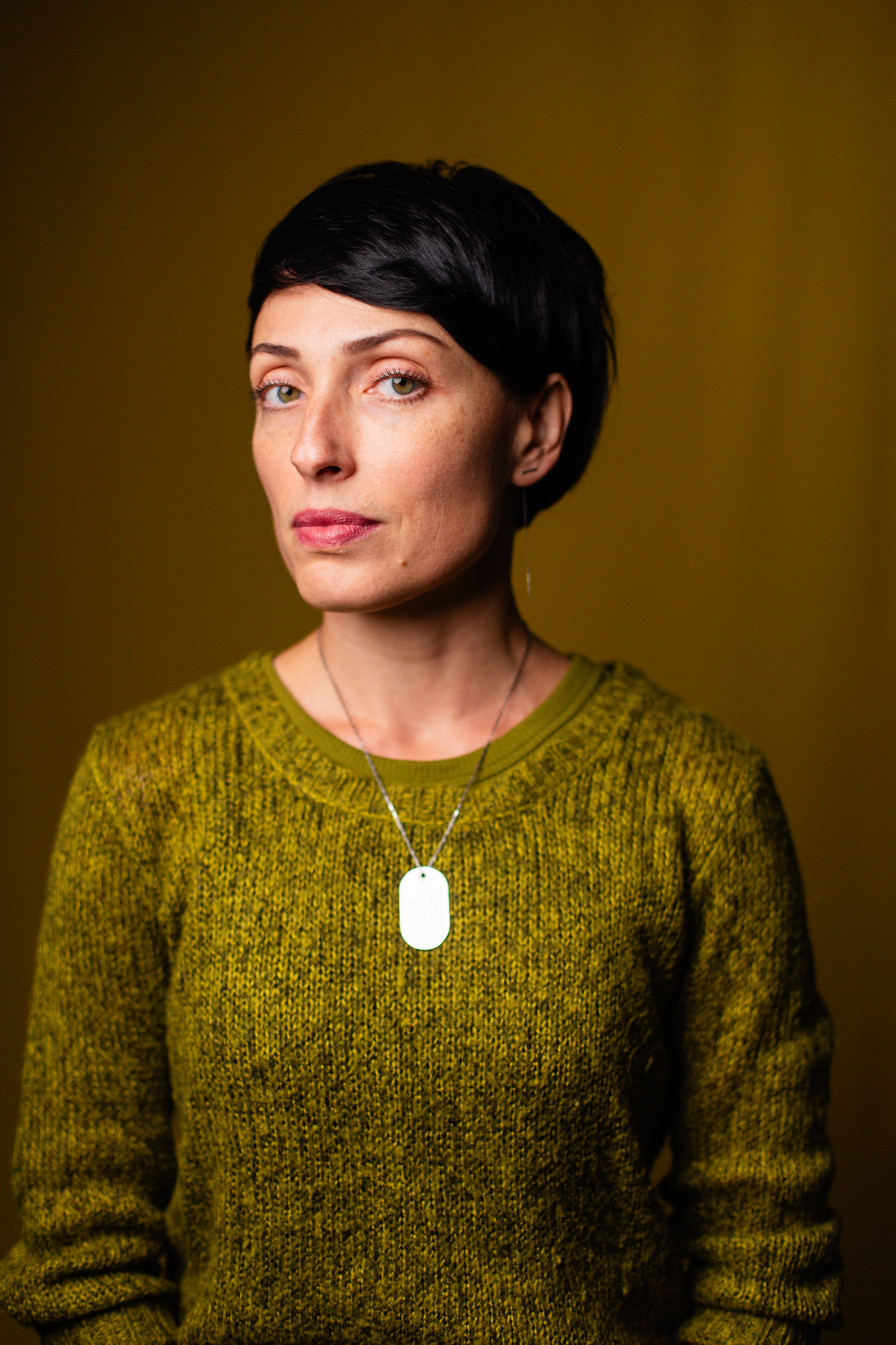
Olha Birzul during the interview, 2025
photo: Post Bellum Ukraine

Olha Birzul is a film curator and cultural manager. She was born on August 20, 1982, in Kyiv, but spent a significant part of her childhood and youth in Nizhyn. She studied Ukrainian and English philology at Nizhyn University. While working on her thesis, she studied Ukrainian postmodernism. She also has degrees in journalism and design. She participated in the Orange Revolution. In 2009, she joined the team of the human rights documentary film festival Docudays UA. From 2016 to 2019, she curated the festival’s cultural diplomacy project See Ukraine. She later headed the film department at the Ukrainian Institute. In the summer of 2022, due to Russia’s full-scale invasion of Ukraine, she moved to Vienna, but returned to Kyiv a year later. In 2024, Olha Birzul’s book, Your Book About Cinema, was published, which she dedicated to her husband, Viktor Onysko, a film director and a fallen defender of Ukraine. After the loss of her husband, she began volunteering at a camp run by the UA Ants NGO, which supports the families of fallen soldiers. In 2025, she joined a test group of experts reforming the “Art” discipline in schools.