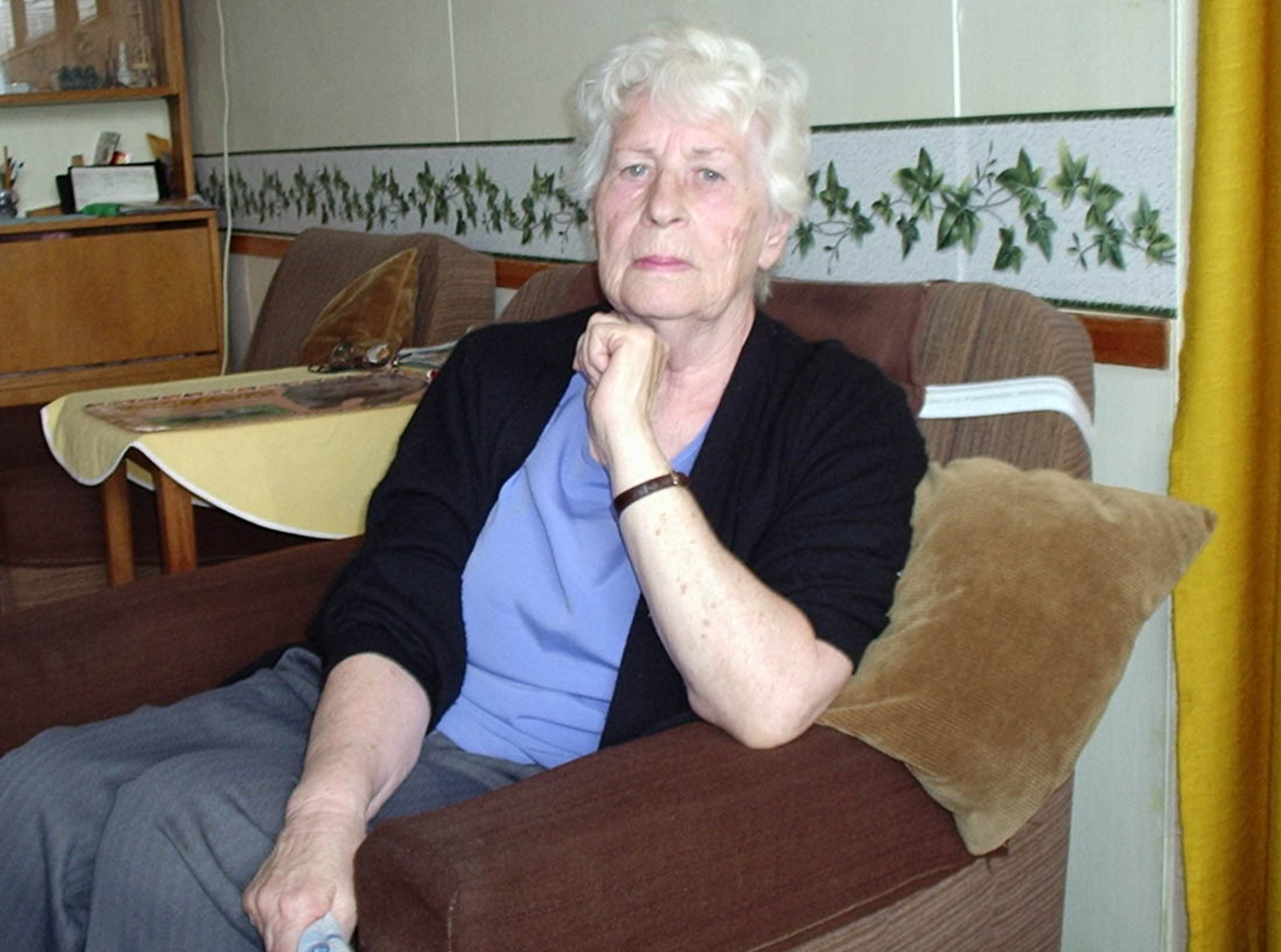
“The worst time for me was when he left and I had no news of him. At first he wrote me that they were going to the front. He was then in France, Italy, they had to take some detours. So he was writing to me, once he even sent some toy for our little Mirek. But then he stopped and I did not know anything about him till the end of the war. The war ended and I did not know whether he was alive or dead. Two months afterwards I received a letter from the Red Cross, saying that he had been interned and that he was still alive.”
“I met one doctor here, an Englishwoman, who lived in Prague. She invited me to her place and told me it was not all right for me, an intelligent woman, just to sit in some forsaken village house and do nothing. She suggested I might work in the Czech Press Office, so I went there to inquire and they employed me. So even though we lived in Rokytnice in the Orlické Mountains, I started to work in the Czech Press Office. I would be in Prague the whole week, and on the weekends I would go home to Rokytnice to take care of the household and children; they were already older. This time was better than what we had experienced before. I did not have to do manual work in the fields as before, but I had this better job.”
We were both idealists and at first we believed that communism was a good thing. But very soon we began to realize that Russian communism was not what we imagined. Moreover, my husband was used to being outspoken about his opinions, and this was very dangerous. He became unwelcome very quickly. I thought about returning to England, but my husband did not. He said that he had fought for his country, and therefore he would stay and help to rebuild his homeland.”
“The war was over and I did not know whether my husband was alive or dead. Then, about two or three months later, I received a letter from the Red Cross that they found him in an Austrian concentration camp. When the situation became better, he came to England for me. Towards the end of 1945 we arrived to Prague. I did not care where we would live, but he insisted on going home. So we came here. The beginnings were enormously difficult. My husband still suffered from physical complaints caused by his internment in the concentration camp. He had ulcers all over his body, it took him about half a year to get rid of them. He did not wish to remain in the army afterwards, he wanted to lead a civilian life. So he was looking for a suitable job, and the first position he found was a caretaker in a hotel in Špindlerův Mlýn, which was left behind by the Germans who had owned it before. But it did not suit him very much, so he was looking for another job, and we moved again. He was willing to take up any employment, what mattered to him most was that he would at home.”
Lucy Doležalová, née Westcott, was born on April 15, 1922, in Worcestershire, Great Britain. In 1942, she married Jan Doležal, an officer in the Czechoslovak Independent Armored Brigade, which was part of the Czechoslovak units abroad. A year later, her husband was drafted to the Eastern Front, where he was captured during the fighting at Dukla. The Nazis then imprisoned him in the Mauthausen concentration camp, where he remained until liberation. After the war, the Doležals were reunited and left together for Czechoslovakia, where they subsequently joined the Communist Party of Czechoslovakia. However, they left the party after the invasion of Warsaw Pact troops in 1968. Lucy Doležalová worked as a news translator at the Czech Press Agency from 1962 until her retirement. In retirement, she devoted herself to translating books into English and volunteered at the Sue Ryder Home. She and her husband raised three children: their eldest son Alan Miroslav, born in 1943 in Great Britain, and their younger son Stanislav and daughter Tamara, who were born in Czechoslovakia. Both sons later emigrated to Australia. Jan Doležal died in 1978. Lucy Doležalová died on October 29, 2010.